
Search Washington Property Records
Washington property records are public documents held at the county level across all 39 counties in the state. You can search and obtain these records through county assessors, county auditors, and several state-level online tools. Whether you need a deed, a tax assessment, a recorded lien, or historical ownership data, this guide explains where to look, how to request documents, and what laws govern public access to property information in Washington.
Washington Property Records Overview
Washington Property Records Overview
Washington State does not maintain a single statewide property database. Instead, property records are split between two county offices. The county assessor handles valuation and tax records. The county auditor handles the recording of deeds, mortgages, liens, and other instruments that affect title. Both offices are public resources, and most of what they hold is open under Chapter 42.56 RCW, the state Public Records Act.
Because Washington uses a county-based system, the tools and portals you use will depend on which county the property sits in. King County has its own dedicated parcel viewer. Spokane and Pierce counties run their own online search systems. Smaller counties may rely more on in-person requests. The Washington Department of Revenue's county assessor and treasurer directory is the best single starting point. It links directly to every county's local portal.
Washington property records are primary sources for real estate transactions, title research, tax disputes, and ownership verification. They are not locked behind agency approval. You don't need a reason to look. Anyone can access them.
The Washington Department of Revenue county assessor portal serves as the central gateway to all 39 county assessor and treasurer websites statewide.
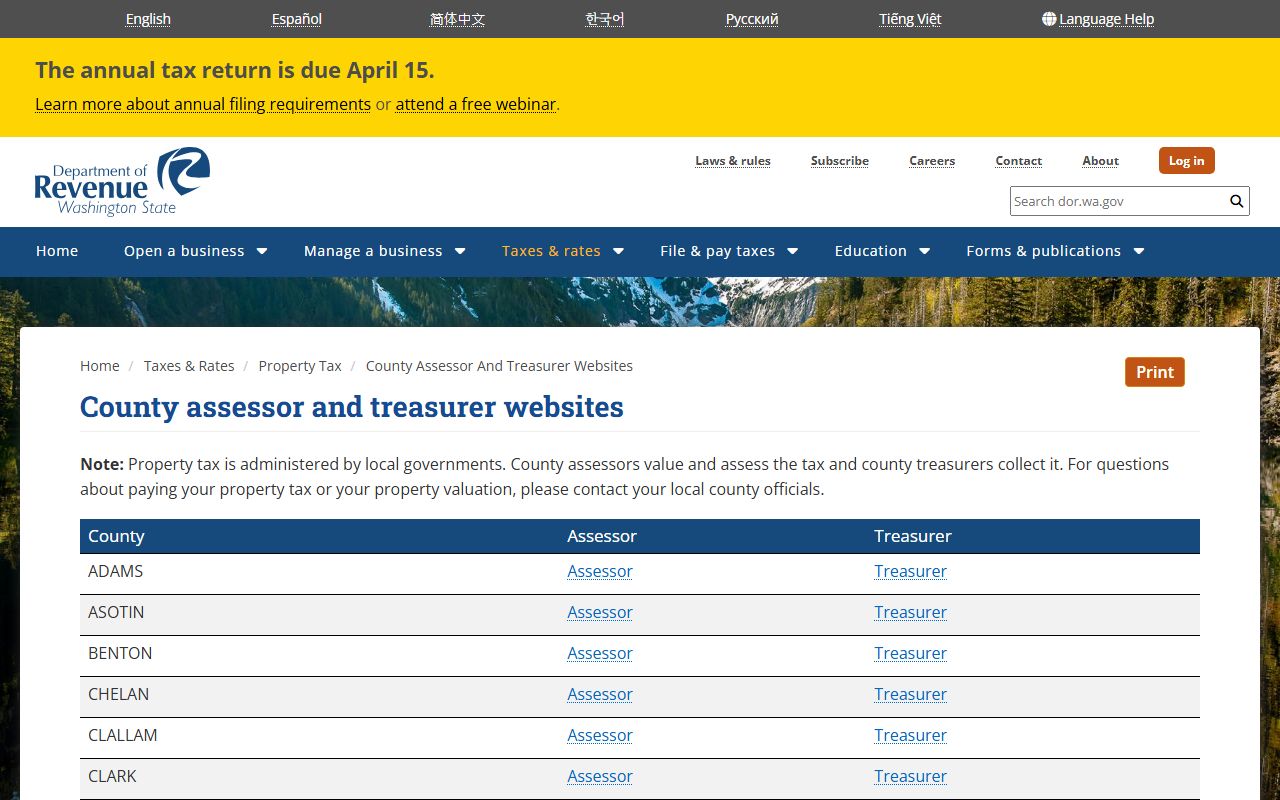
Use this DOR page to jump directly to any county's local property search system without having to hunt for individual websites.
How to Find Washington Property Records
Start with the county where the property is located. Every county in Washington has two offices that together hold the bulk of property-related documents: the assessor and the auditor. The assessor's records include the tax parcel number, assessed value, property description, ownership name, and any exemptions on the parcel. The auditor's records hold every recorded document that has passed through the office, including deeds, deeds of trust, releases, easements, plats, and notices of lis pendens.
Most counties now offer online search tools. You can usually look up a parcel by address, owner name, or parcel number without visiting in person. Some systems let you view and download recorded documents directly. Others show summary data and require you to go to the office or submit a written request for copies. Fees for copies vary. Most counties charge per page for plain copies and a higher rate for certified copies.
If you can't find what you need through the county, the Washington State Archives Digital Archives is worth checking for historical records. The Digital Archives holds Real Property Record Cards for many counties, including King and Spokane, with tax assessments, ownership histories, and photos from the 1930s and 1940s.
The Washington State Archives Digital Archives hosts millions of historical property records, including early tax assessment cards for King and Spokane counties: Washington State Archives Digital Archives.
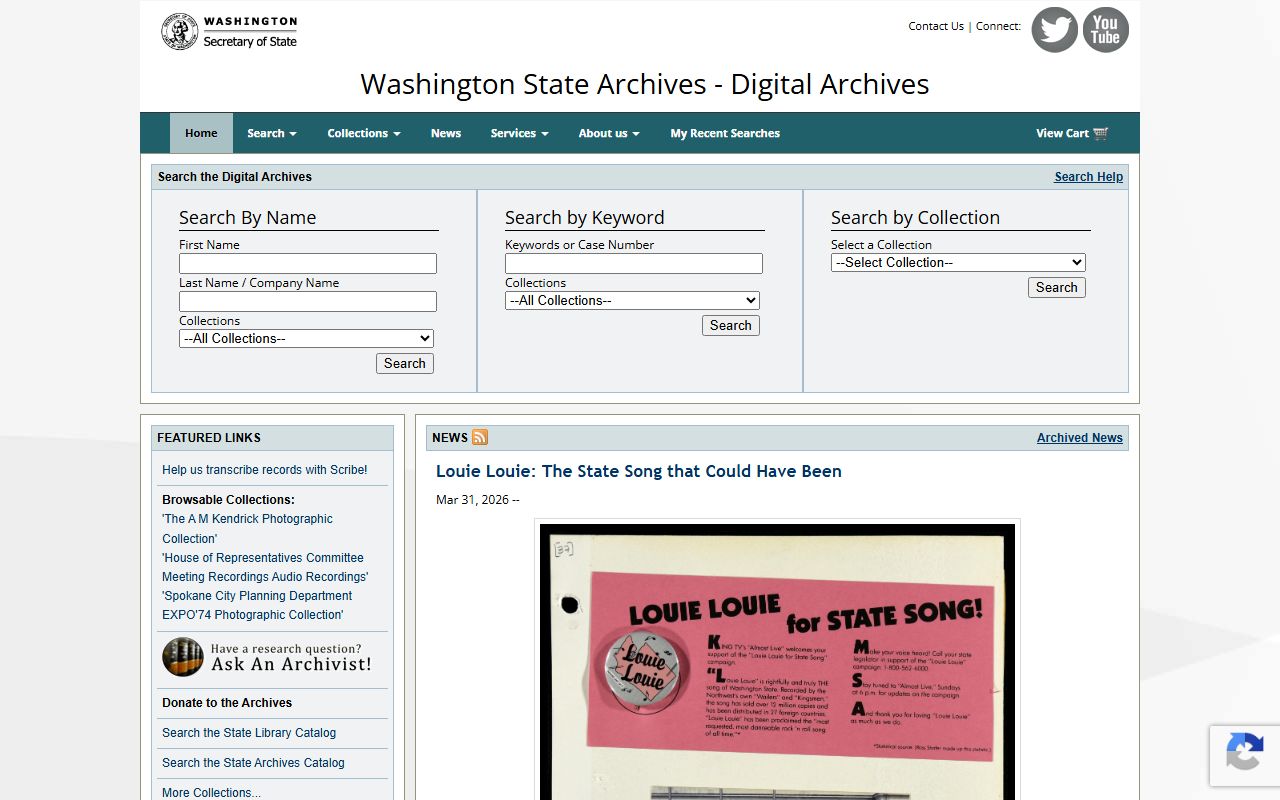
For historical chain-of-title research, the Digital Archives is often the only source for records predating modern computerized systems.
Washington County Assessor Records
The county assessor is the first stop for property tax and valuation information. Under Chapter 36.21 RCW, county assessors are responsible for determining the value of all taxable real and personal property in both incorporated and unincorporated areas of their county. This work ensures that property taxes are applied equitably across all taxing districts. Assessors also administer exemption and deferral programs for senior citizens and disabled persons.
Washington law requires that all real property be assessed every year with reference to its value on January 1. That date is set by RCW 84.40.020. Assessors use a continuous revaluation cycle to keep values current. Properties in most counties are physically inspected and revalued on a rotating schedule. The assessed value drives what property owners owe in taxes each year.
Assessor records are public. You can look up a parcel's assessed value, owner of record, legal description, land area, and improvement data through the county's online system. Tax parcel maps and property sketches are also typically available. If you disagree with an assessed value, you can appeal to the county board of equalization.
The Washington State Treasurer's county assessor and treasurer directory confirms that property taxes are administered locally, with no single statewide assessment database.
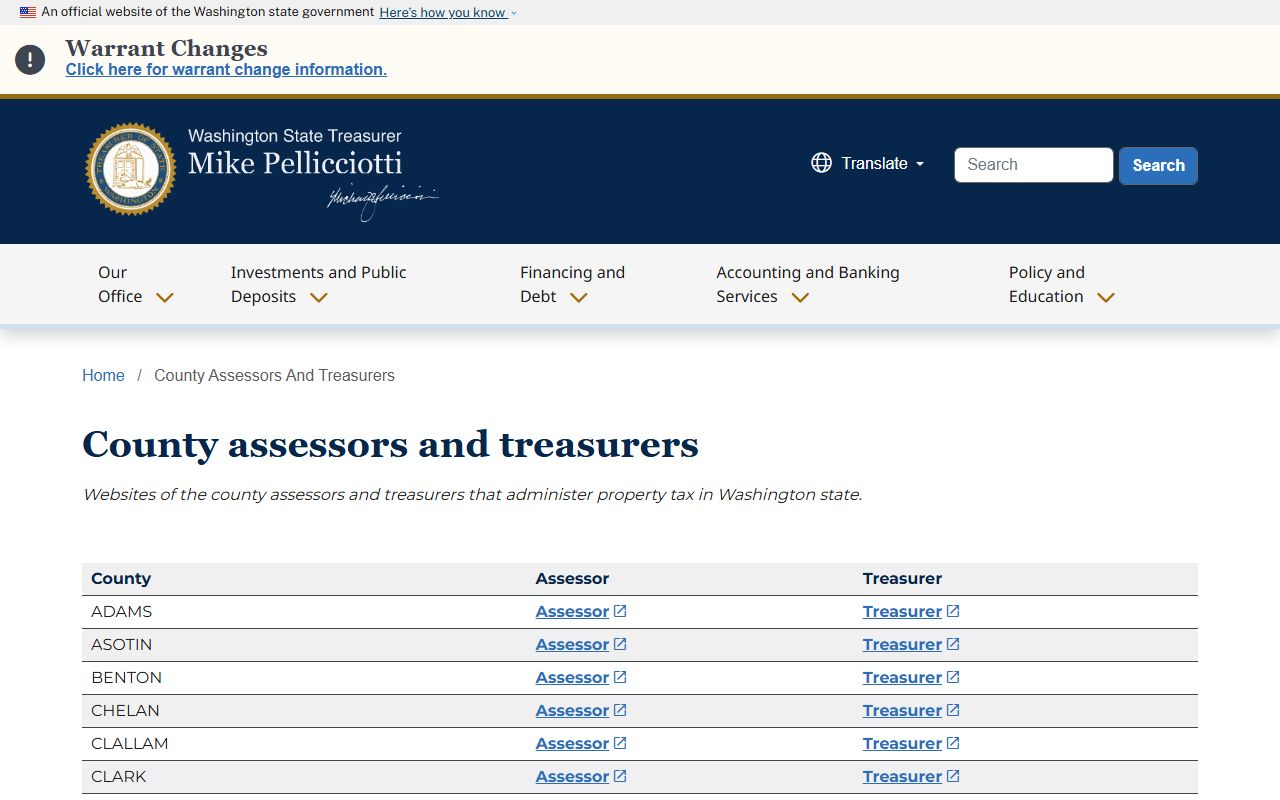
The State Treasurer's directory is useful for confirming the split between assessment duties (assessor) and tax collection duties (treasurer) in each county.
Note: A taxpayer who disagrees with the assessor's valuation must file an appeal with the county board of equalization before the deadline, typically July 1 of the assessment year.
Recording Property in Washington State
When real estate changes hands or a lender places a lien on property, the transaction documents must be recorded with the county auditor in the county where the property sits. County auditors serve as the official recording officers under RCW 36.22.010. Recording creates a public record of the transaction and provides constructive notice to anyone who searches later.
Under RCW 65.08.070, the term "conveyance" covers a broad range of instruments. Deeds, deeds of trust, mortgages, releases, assignments, easements, and plats all qualify. The county auditor has a ministerial duty to record any document that appears on its face to affect title to real estate, as long as the proper fee is paid. The auditor cannot refuse recording simply because of doubts about the legal standing of the submitting party. This principle is confirmed by a Washington Attorney General opinion on the duty of county auditors.
The Washington Attorney General has issued a formal opinion on recording obligations: AG Opinion on Duty of County Auditors and Treasurers to Record Documents.
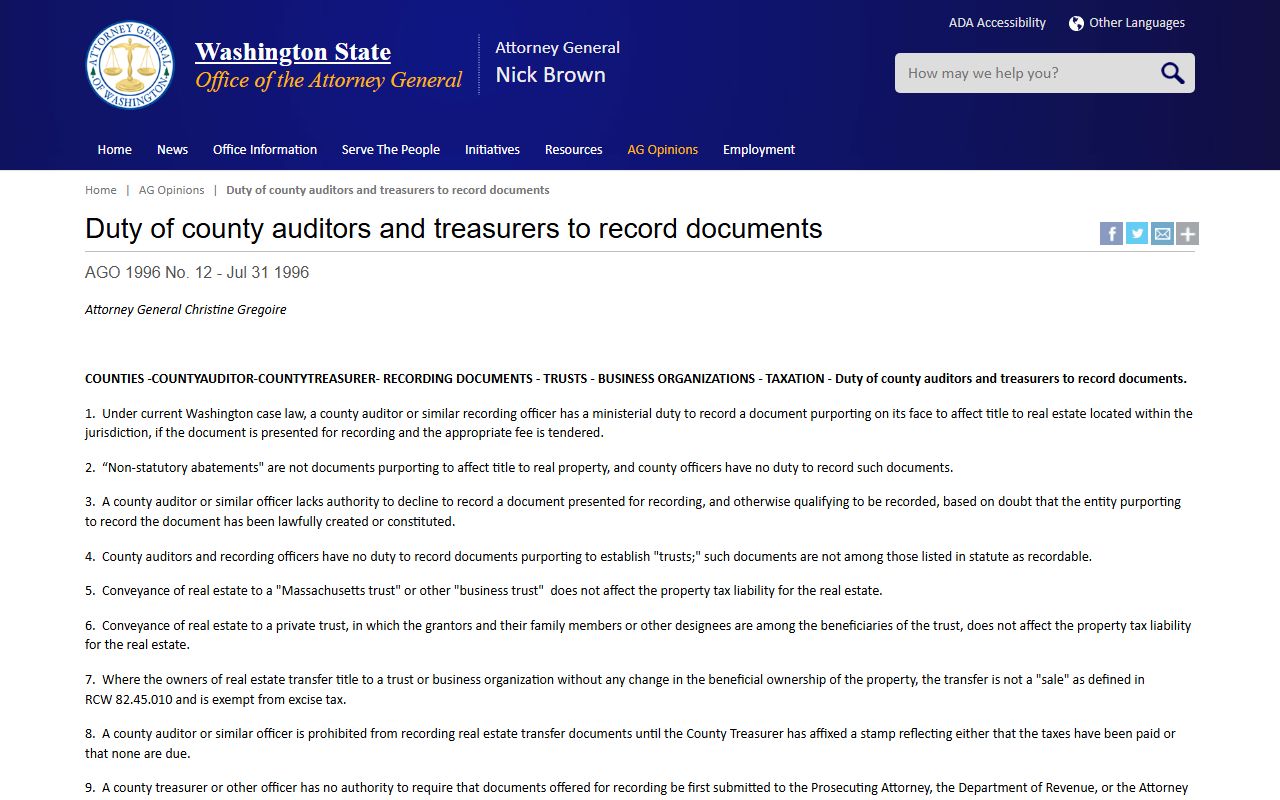
This AG opinion is an authoritative reference for understanding what recording officers are required to accept and what protections recording provides to buyers and lenders.
Recording is critical for title protection. An unrecorded instrument may be valid between the parties but is void against a subsequent buyer or lender who records first without knowledge of the earlier transaction. This "race-notice" principle under Washington law means that recording promptly after closing is not optional for anyone who wants their interest protected.
Before a real estate transfer document can be recorded, the county treasurer must confirm that property taxes are paid or that none are due. The treasurer affixes a tax stamp to that effect, and only then can the auditor record the deed.
Washington Property Tax Records
Property tax records in Washington show the assessed value of a parcel, the levy rates applied by various taxing districts, and the amount owed or paid each year. These records are held by the county assessor and county treasurer. The assessor sets the value. The treasurer bills and collects. Both sets of records are public.
Washington assessors use fair market value as the standard for all taxable property. The state Department of Revenue provides oversight and publishes the County Assessor's Manual to standardize appraisal practices across all 39 counties. The DOR's Property Tax Division monitors compliance and can review county valuation methods if problems arise. Levy rates vary by taxing district, so two parcels with the same value in different parts of the same county may carry different tax bills depending on which school district, fire district, and other taxing authorities apply.
Tax records are especially useful for verifying ownership and tracking property history. They show the owner's name as of the assessment date, which is January 1 each year. If ownership changed mid-year, the new owner may not appear in tax records until the following year, but the recorded deed at the auditor's office will reflect the current owner immediately after recording.
County treasurer records also show tax payment history, delinquencies, and any active foreclosure proceedings. County treasurers handle tax foreclosure proceedings when taxes go unpaid for extended periods. These foreclosure records are public and can affect title.
Note: Property tax exemptions for seniors and disabled homeowners are administered by the county assessor under RCW 84.36.381 and require annual application in most counties.
Searching Property Records Online
Washington property records can be searched online through several official channels. The level of detail and the ease of access varies by county. Larger counties typically offer full parcel viewers with document images. Smaller counties may only offer basic parcel data online, with full documents available in person or by mail.
The DOR's county assessor and treasurer directory is the cleanest path to county-level search tools. From there you can reach King County's iMap parcel viewer, Spokane County's parcel search, Pierce County's property search, and the equivalent tools for every other county. Each county's system has its own interface, but most let you search by address, parcel number, or owner name.
The MRSC provides guidance on the county assessor's role and how assessor records are structured: MRSC County Officials Role Guide.
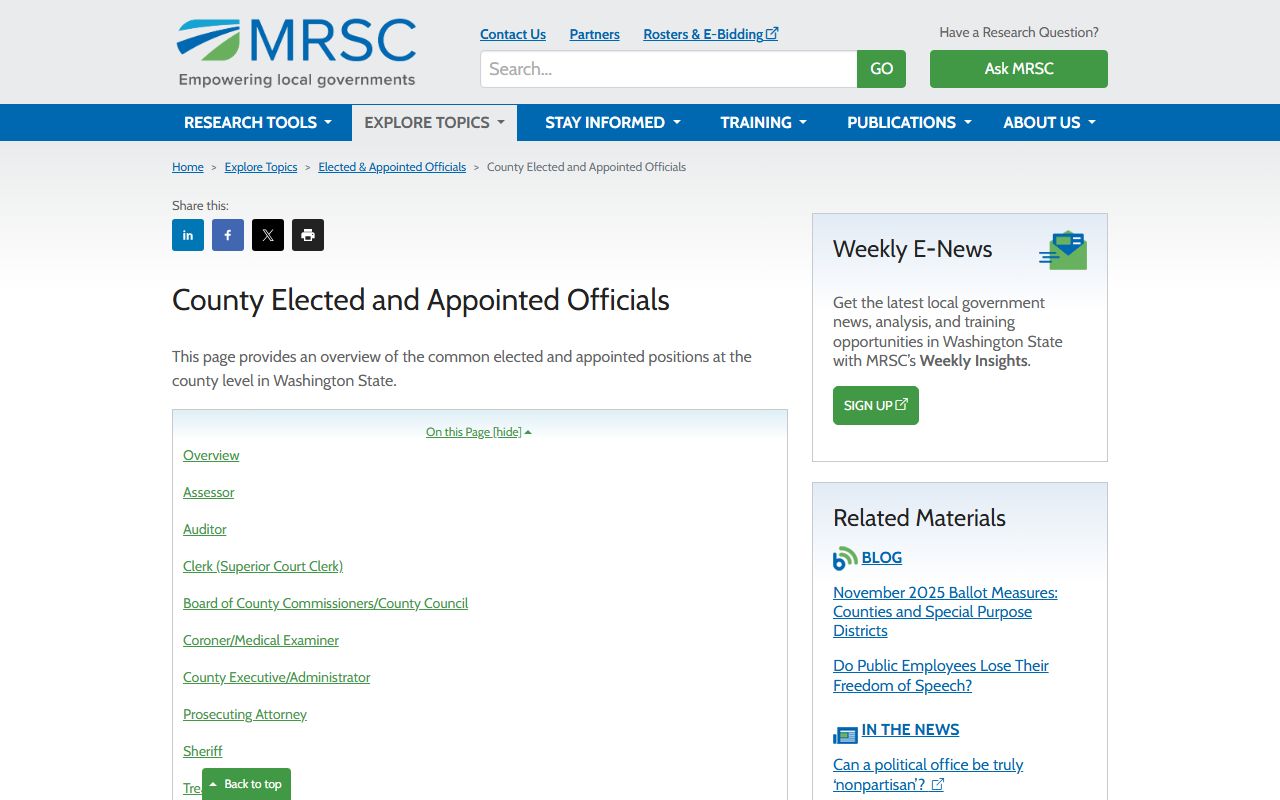
Understanding what the assessor is responsible for helps you know what to expect when you search a county assessor database.
For business entities that hold real property, the Washington Secretary of State Corporations and Charities Filing System can help you trace corporate or LLC ownership. While the SOS does not hold deed records, it identifies the registered entity behind a property owner name, which is often essential when researching commercial real estate.
State trust lands managed by the Department of Natural Resources have their own records system. The DNR land transactions page covers trust land exchanges, fee transfers, and the Urban Transition Lands Program, with an interactive map of state-owned parcels.
State Archives and Historical Records
For property research going back before the modern era, the Washington State Archives system is the main resource. The Digital Archives at digitalarchives.wa.gov holds Real Property Record Cards for many counties. These cards were created in the 1930s and 1940s during government assessment campaigns. They contain ownership names, tax values, construction dates, building sketches, and photographs of structures as they existed at the time of assessment.
To search the Digital Archives by parcel number, enter the 10-digit parcel number with a hyphen between the sixth and seventh digits. For address searches, leave out street directionals and suffixes for the best results. The archive is free to use and does not require registration.
The Seattle Municipal Archives offers a useful guide to property history research in Seattle and King County: Seattle Municipal Archives Property History Resources.
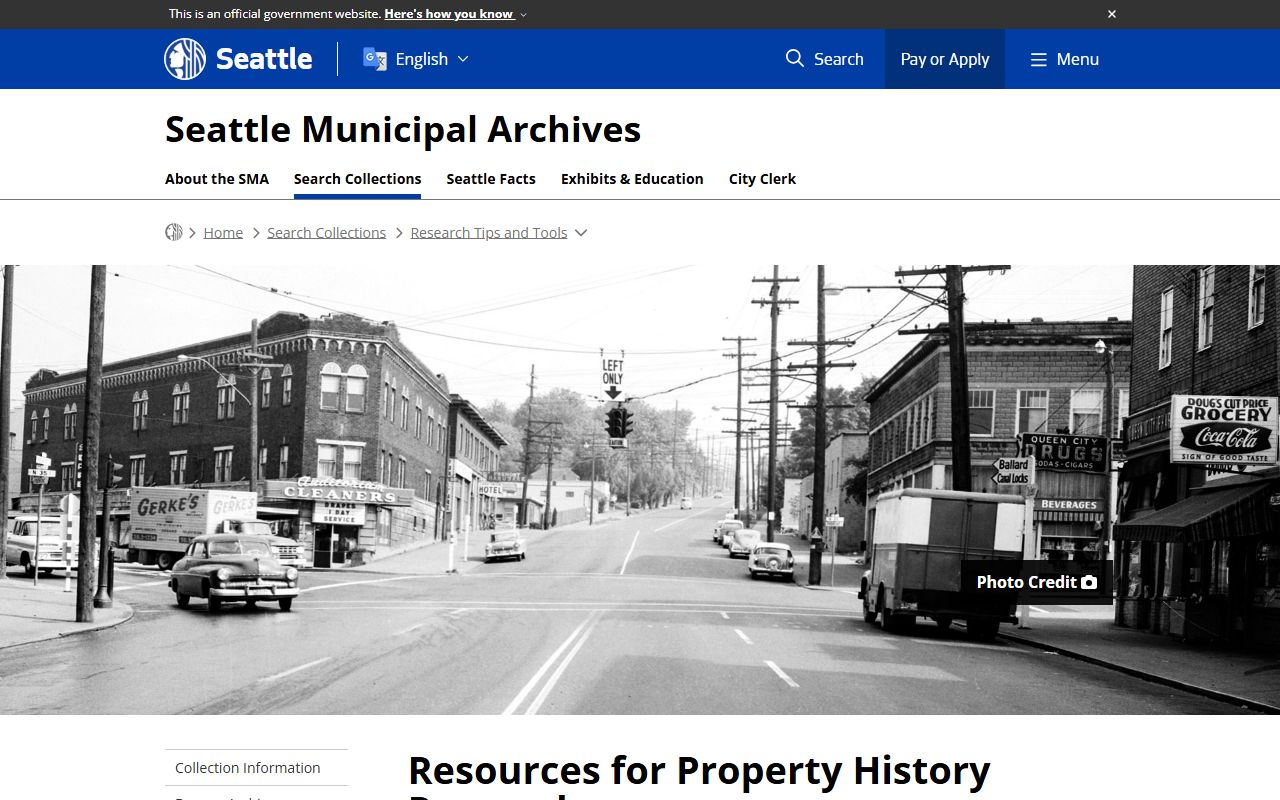
The Seattle guide points to sources beyond the assessor, including the King County Recorder's Office, the Seattle Department of Construction and Inspections microfilm library, and Sanborn fire insurance maps at the Seattle Public Library.
Physical archives are also available at regional branches of the Washington State Archives. The Puget Sound Regional Branch holds King County Assessor property tax records with photographs from the 1930s and 1940s. These records are useful for chain-of-title research, historic preservation work, and genealogy. The Eastern Washington branch serves counties east of the Cascades.
Note: The Seattle Department of Construction and Inspections holds building permits from the 1890s to the present, which can help establish when a structure was built and what changes were made over time.
Washington State Property Laws
Several key statutes govern property records and public access in Washington. Knowing the relevant laws helps you understand what you can request and what restrictions may apply.
Chapter 42.56 RCW, the Washington Public Records Act, is the foundation for public access to government records. Under this statute, all records of a public agency are presumed open unless a specific exemption applies. County assessor and auditor records fall within its reach. Requests must be responded to promptly. Agencies cannot demand you state a reason for the request.
RCW 84.40.020 requires that all real property be assessed every year as of January 1. This is the statutory basis for the annual assessment cycle used by all 39 Washington counties. The assessed value set on that date is the one used to calculate property taxes for the coming year.
RCW 65.08.070 defines conveyances broadly to include any written instrument that creates, transfers, mortgages, or assigns an interest in real property. This is the recording statute. Under RCW 65.04.080, auditors must record qualifying instruments without delay once the fee is paid. Chapter 36.21 RCW covers the general duties of the county assessor, including valuation, levy calculation, and exemption administration.
The seller disclosure law under RCW 64.06.080 requires sellers of residential property to complete a written disclosure statement covering the condition of the property. The MRSC seller disclosure page maintains a directory of additional local disclosure requirements imposed by cities and counties beyond state law.
MRSC tracks local seller and landlord disclosure requirements that go beyond state law: MRSC Landlord and Seller Disclosure Requirements.
Local disclosure rules in Seattle, Tacoma, and other jurisdictions add requirements beyond the state form, so checking this page before a transaction is worth the effort.
The Department of Revenue's public records rules under Chapter 42.56 RCW note that some property-related tax information is confidential under RCW 84.08.210, including income data submitted to assessors in connection with income-based property valuations. The DOR also prohibits releasing lists of taxpayers for commercial purposes.
Additional Resources for Property Research
Washington offers several additional resources beyond county offices and the DOR directory. Depending on what you need, one or more of these may save you time or fill in gaps that county-level systems don't cover.
The Washington Department of Revenue public records page explains how to submit public records requests to the DOR directly. While much of DOR's collected data is confidential under RCW 82.32.330, public information including business lookup tools, tax statistics, and the Taxpedia online research tool is available through their website.
The Washington DOR also maintains public records about property tax administration and oversight statewide: Washington Department of Revenue Public Records.
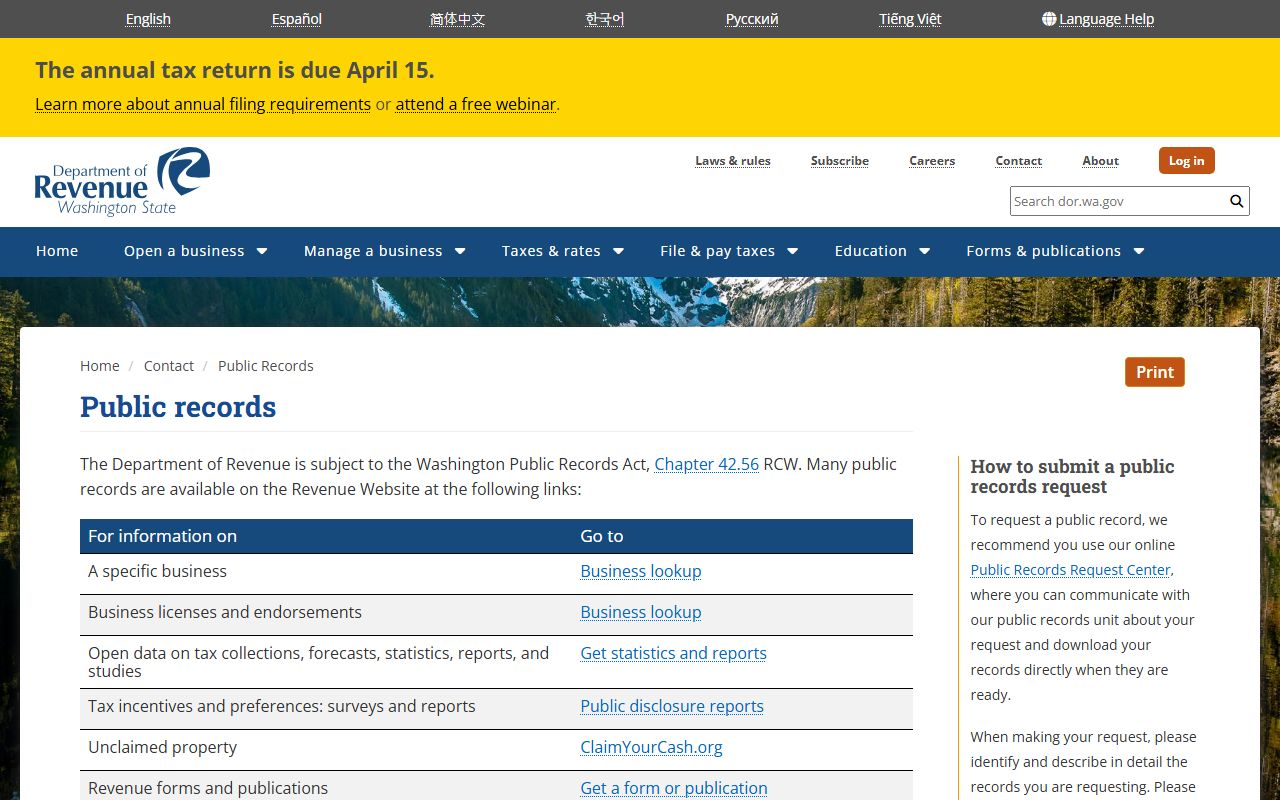
Use the DOR public records portal to request data about statewide property tax practices, oversight decisions, and assessor manual guidance not available at the county level.
For state-owned lands, the Department of Natural Resources land transactions page covers the more than 3 million acres of state trust forest, agricultural, and commercial properties managed by DNR. The Trust Land Transfer program, established in 1989, allows DNR to reposition state trust lands to better serve schools and other beneficiaries. An interactive map shows current parcel locations for the Urban Transition Lands Program.
The Washington Legislature's RCW online portal at wa.elaws.us provides direct access to the statutory text of recording and assessment laws. This is useful when you need to verify the exact language of a statute cited in a title report or legal opinion.
Washington property research can also involve:
- County treasurer records for tax payment history and foreclosure proceedings
- County auditor indexes for all recorded instruments by grantor or grantee name
- Plat maps and subdivision records at the county auditor or planning department
- State Archives regional branches for pre-digital assessment and ownership records
- Fire insurance maps (Sanborns) at public libraries for historical building data
- DNR parcel data for identifying state-owned land within a search area
- Secretary of State filings for corporate or LLC ownership of commercial properties
Browse Washington Property Records by County
Washington property records are managed at the county level. Each of the 39 counties has its own assessor and auditor who handle valuation and recording respectively. Pick a county below to find local property search resources, contact info, and recording office details.
View All 39 Washington Counties
Washington Property Records in Major Cities
City residents in Washington file and search property records through the county office serving their area. Select a city below to find which county handles property records for that location and how to access them.