
Seattle Property Records
Seattle property records are maintained by King County, which handles assessment, recording, and tax billing for all parcels within the city. You can search ownership data, assessed values, deed records, parcel maps, and permit history through King County's online tools and the city's own open data resources. Most records are free to view online, and copies of recorded documents are available through the King County Recorder's office. This page explains where to look, what each source contains, and how to get what you need.
Seattle Overview
Seattle Property Records Overview
All Seattle parcels fall within King County. That means one set of offices handles assessment, recording, and tax administration for the entire city. The King County Assessor values each parcel, the King County Recorder stores deeds and other documents, and the King County Treasurer collects property taxes. The King County Assessor maintains the primary public database for ownership information, assessed values, parcel boundaries, and sales history. You do not need to pay or register to use it.
Under RCW 84.40.020, all real property in Washington must be assessed at 100% of true and fair market value as of January 1 each year. Assessment records are open for public inspection, so anyone can look up current ownership, assessed land value, improvement value, and property characteristics for any Seattle address. The Washington Public Records Act under Chapter 42.56 RCW confirms that right of access statewide.
Seattle is the largest city in Washington. Parcel values here tend to be among the highest in the state. The assessor updates values on a rolling schedule, and property characteristics are revised when new permits are pulled or sales are recorded. If you need current data, the online portal reflects recent changes more quickly than printed records do.
King County Assessor Seattle Property Data
The King County Assessor is the main source for Seattle property records. The eReal Property search tool lets you look up any parcel by street address or parcel number. Results include the current owner of record, assessed land and improvement values, lot size, building square footage, year built, and prior sale history. The tool is at blue.kingcounty.com and is free to use without an account. Most Seattle parcels have photographs and detailed building data on file.
The assessor's office also runs several tax relief programs for eligible property owners. Senior citizens, disabled veterans, and persons with qualifying disabilities may apply for reductions in assessed value or tax liability. These programs are administered under state law, and the assessor's staff can help you determine whether you qualify. Details are available at the main assessor portal at kingcounty.gov/en/dept/assessor.
For spatial data and parcel boundary information, the King County GIS Open Data Portal at gisdata.kingcounty.com offers downloadable layers for parcel boundaries, zoning classifications, aerial imagery, and environmental overlays. This is helpful for planning analysis or any research that goes beyond the standard address lookup. Layers cover all of Seattle and can be exported in common GIS formats.
Note: If you believe the assessor has the wrong data for your parcel, you can request a correction through the assessor's office. Disputes over assessed value are handled by the King County Board of Equalization, not the assessor directly.
Seattle City Resources for Property Research
The Seattle official website is the starting point for city-level property resources. The Seattle Department of Construction and Inspections (SDCI) handles building permits, land use decisions, code compliance, and design review. Permit records show construction history, scope of work, and inspection outcomes for any address in the city. That data complements what you find at the county assessor's office, especially for properties with recent improvements or additions. The SDCI section of the city site also covers land use approvals, environmental review, and zoning decisions that affect property use.
Seattle official website with property and permit services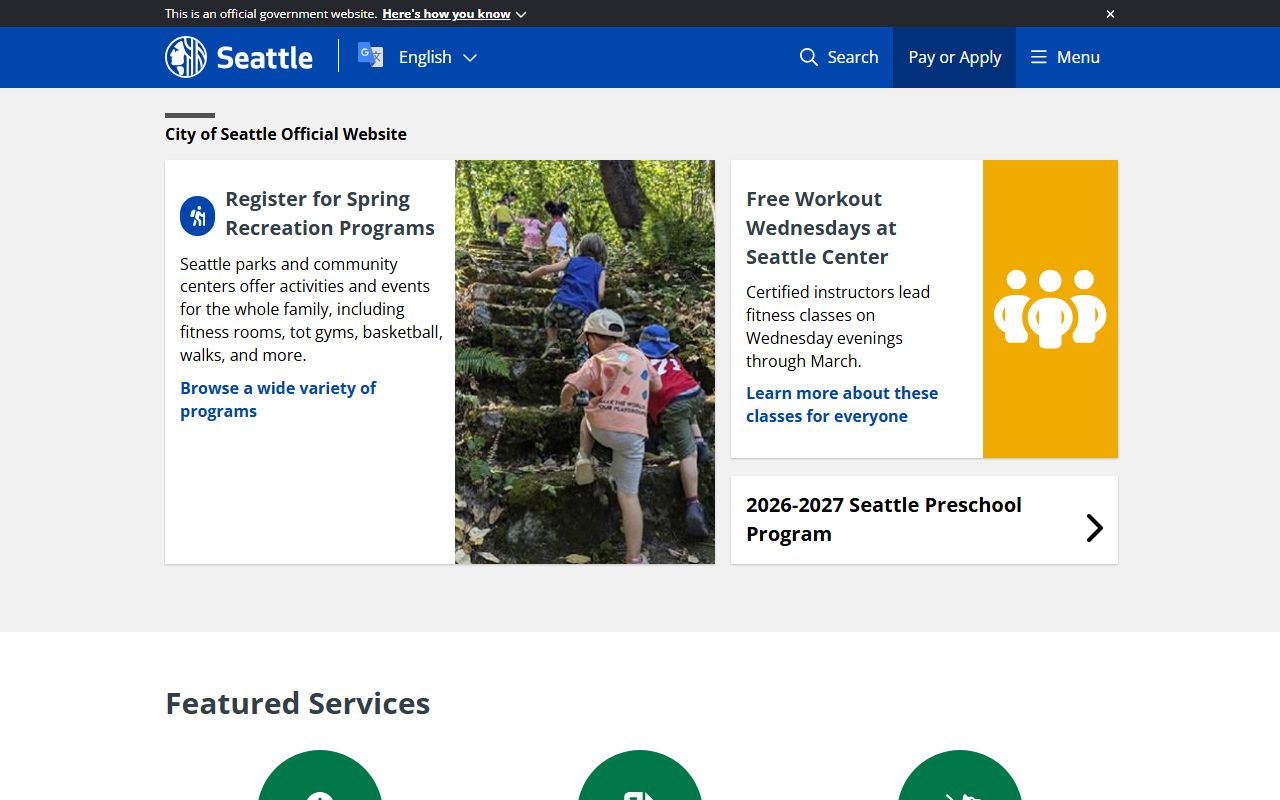
The Seattle.gov portal connects you to building permits, SDCI services, and city public records for Seattle properties.
Building permits in Seattle are searchable through the Seattle Services Portal, accessible from the SDCI section of the city site. You can search by address to see active permits, past permits, and scheduled inspections. This is useful if you are researching a property's improvement history or checking whether unpermitted work was done. The city does not charge a fee to view permit records online.
The city also provides zoning maps, noise enforcement records, and land use approval documents through the main portal. Seattle's planning department manages comprehensive plan materials and land use code information, which affect what can be built on a given parcel.
Recording Seattle Property Documents
Deeds, mortgages, deeds of trust, liens, easements, and other instruments affecting Seattle real estate are recorded with the King County Recorder. Under RCW 65.08.070, a conveyance is not effective against a subsequent bona fide purchaser unless it is recorded. Recording creates constructive notice to the world, which is why title companies make recording a standard step in every real estate closing.
The King County Recorder accepts documents in person at the King County Administration Building in downtown Seattle, or through authorized eRecording services. Documents must meet formatting standards under RCW 65.04.045, including margin size, legible text, and a completed cover sheet. The county auditor serves as recording officer under RCW 36.22.010 and must record qualifying documents without delay once fees are paid. Most professional closings use eRecording because it is fast and does not require a trip to the building.
You can search recorded documents through the King County Recorder's online system by grantor or grantee name, parcel number, or document type. Documents recorded after a certain date are available as scanned images. Older documents may require a visit to the King County Archives or a formal records request.
Before a deed or transfer document can be recorded, the county treasurer must confirm that property taxes are current. This step happens automatically in most closings handled by title companies, but if you are doing a transfer on your own it is an important step to be aware of.
Seattle Open Data Property and Permit Records
The Seattle Open Data portal at data.seattle.gov provides free access to city datasets covering property parcels, building permits, land use, and zoning. Researchers, developers, and property professionals can download data directly or connect through APIs. Datasets are published by multiple city departments and updated on a regular schedule. Two of the most used datasets are the Real Property Parcel layer and the Building Permits dataset, which together give a detailed picture of Seattle's built environment and ownership patterns.
Seattle Open Data portal with property and permit datasets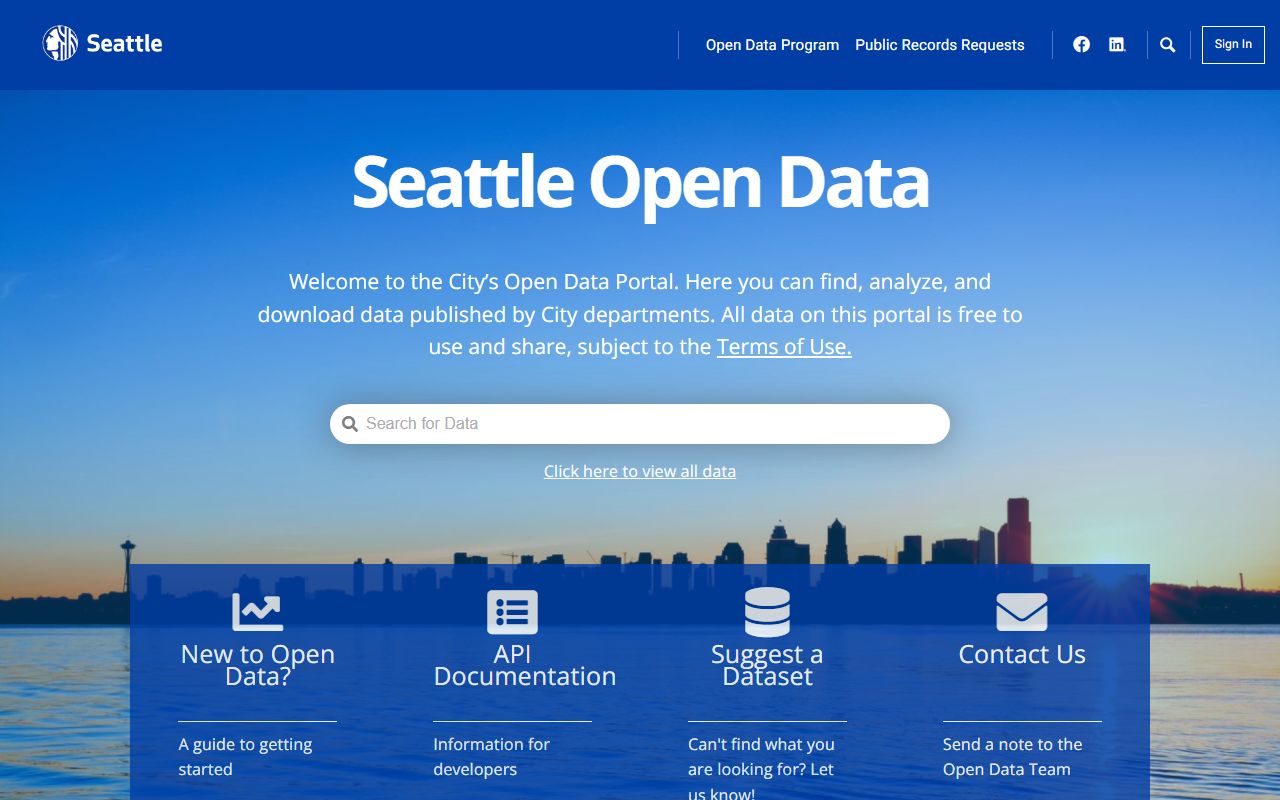
The Seattle Open Data portal lets you download parcel data, building permit records, and land use datasets for bulk research and analysis.
The open data portal supports transparency around Seattle real estate. You can pull permit counts by neighborhood, track ownership changes over time, or map parcel boundaries against zoning layers. For anyone doing large-scale research or building a data project, this portal is more practical than the standard address lookup tools. It is free to use and does not require an account.
Property Tax Records for Seattle Owners
Seattle property owners pay taxes to multiple taxing districts stacked on top of each other. These include King County, the City of Seattle, Seattle Public Schools, Sound Transit, the Port of Seattle, King County Metro, library districts, and several other special purpose districts. Each district sets its own levy rate. Those rates are combined and applied to the assessed value to produce the annual tax bill. Seattle's overall levy rate is among the higher ones in the state due to the number of active taxing districts.
Real estate excise tax (REET) applies when property changes hands. The rate is governed by RCW 82.45. Washington uses a graduated structure, meaning higher-value sales are taxed at a higher rate. For high-value Seattle properties, REET can be a significant cost at closing. The tax is typically collected by the title company and remitted to the county treasurer before the deed is recorded.
Property taxes in King County are due in two installments. The first half is due by April 30 and the second half by October 31. Late payments accrue interest and penalties. The King County Treasurer handles billing, collection, and delinquency proceedings for all Seattle parcels. The Washington Department of Revenue publishes a directory of county assessor and treasurer websites at dor.wa.gov, which is useful if you need to reach the right office quickly.
Historical Seattle Property Records
Historical property records for Seattle parcels go back many decades. The Washington State Archives Digital Archives at digitalarchives.wa.gov holds real property record cards for King County with early tax assessments, construction dates, and photographs taken during the 1930s and 1940s. These cards are useful for chain-of-title research, historic preservation projects, or tracing ownership before modern digital records began. Access is free and searchable by address or parcel information.
The King County Archives also holds older deed books, plat maps, and property transfer records that have not yet been digitized. Access to physical archives may require an appointment. For title searches going back to the original plat, a licensed title company or real estate attorney can pull a full chain of title using both digital and physical records.
Plat maps for Seattle neighborhoods are filed with the King County Recorder and can be searched through the recorder's document search tool by subdivision name or plat number. They show lot boundaries, easements, and subdivisions as originally recorded.
Note: Chapter 36.21 RCW governs the county assessor's role and establishes that assessment records are public. This applies to current and historical assessment data held on file by the King County Assessor.
How to Find Seattle Property Records
The fastest way to find a Seattle property record is the King County eReal Property search at blue.kingcounty.com. Enter a street address and you get immediate results: owner name, parcel number, legal description, assessed values, prior sales, and building characteristics. No fee, no account needed. This tool works for all Seattle addresses and most results load in seconds.
For recorded deed copies, use the King County Recorder's document search. Search by grantor or grantee name, parcel number, or document type. Recent documents are available as scanned images online. Older records may need to be ordered or viewed in person at the county archives.
Here are the main tools for searching Seattle property records:
- King County eReal Property - ownership, assessed values, parcel data
- King County Assessor portal - exemption programs, assessment appeal information
- King County GIS Open Data - parcel boundary layers and spatial data
- Seattle Open Data portal - parcel datasets and building permit records
- Seattle.gov / SDCI - individual building permits and land use records
- Washington State Digital Archives - historical property cards and early assessments
If you need a certified copy of a deed or other recorded document, contact the King County Recorder directly. There is a fee for certified copies. The recorder's office can provide copies by mail or in person at the King County Administration Building in downtown Seattle.
King County Property Records
Seattle property records are held by King County. The county assessor, recorder, and treasurer each maintain separate records for Seattle parcels. Visit the King County property records page for more detail on search tools, office locations, recording fees, and county-wide resources.
Nearby Cities
These cities are near Seattle and file property records through King County offices.